
By Abdullahi Bala
In Nigeria, agriculture is more than a livelihood, it is the heartbeat of national sustenance and development. With over 70 percent of the population engaged in farming, either directly or indirectly, the sector represents an enormous opportunity not only for ensuring food security but also for fueling industrial advancement through the use of indigenous raw materials.

Despite its rich agricultural endowment, Nigeria has long struggled to convert this potential into broad-based economic gains. Much of the country’s agricultural output is exported or sold in raw form, fetching only a small portion of its true value. Recognizing this gap, the Raw Materials Research and Development Council (RMRDC) has consistently advocated for a fundamental shift in how Nigeria approaches agricultural development, particularly in terms of integrating production with local processing.
A key element of this strategy is the Council’s 30% value addition policy, which seeks to ensure that every agricultural commodity undergoes a minimum level of processing before it leaves the farm gate. According to the RMRDC 2024 Strategy Paper, the goal is to create jobs, retain economic value locally, reduce foreign exchange leakage, and build an industrial base rooted in what Nigeria grows. Examples of this approach already exist across different sectors: cassava is increasingly processed into starch for pharmaceutical use, and hibiscus flowers are finding commercial applications in the beverage industry. These efforts illustrate the transformative potential of value addition when integrated into national and subnational agricultural planning.

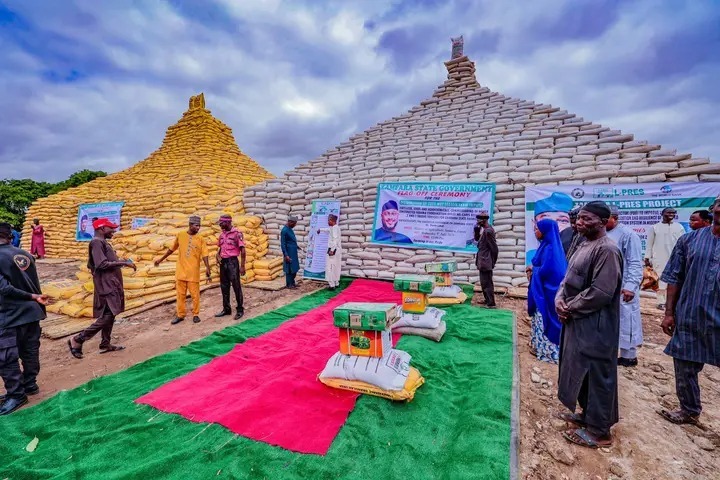
In this regard, Zamfara State has emerged as a strong example of how local government can translate federal vision into tangible impact. On the 9th of July, 2025, Governor Dauda Lawal launched the state’s wet season farm input distribution programme at the Ministry of Agriculture headquarters in Gusau. This initiative represents a major step in Zamfara’s drive to revamp its agricultural sector and align it with RMRDC’s broader industrialization framework.
You Might AlsoLike



Thousands of smallholder farmers across the state received essential inputs aimed at improving productivity. These included large quantities of fertilizer, improved rice seeds, and seed-dressing chemicals. The Governor also deployed dozens of trucks to ensure timely distribution and commissioned a newly constructed Fadama House to support irrigation-based farming.
Governor Lawal described agriculture as the economic backbone of Zamfara. He stressed that the new agricultural drive is about more than increasing food production, it’s about creating a resilient and sustainable system that turns agriculture into a business. With the motto “Farming is Our Pride,” he reaffirmed the state’s commitment to building a full agricultural value chain, from planting to processing and marketing.
What sets Zamfara’s intervention apart is its comprehensive nature. The programme directly addresses key issues such as limited access to inputs, financing gaps, post-harvest losses, and climate-related challenges. The state government is also expanding mechanized services, strengthening extension delivery, and connecting producers with processors to ensure that farming translates into industrial growth.

This integrated approach mirrors RMRDC’s model of linking production to processing. It positions the farm as the foundation of industrial development, enabling every participant in the value chain, from farmers to factory workers, to benefit. The relevance of this model is even more pronounced with the ongoing review of the 30% Value Addition Bill. Once enacted, the bill will require that a significant portion of raw agricultural products be processed within Nigeria before being exported or used in final goods. Zamfara’s proactive strategy could place it ahead of the curve, ready to benefit from this landmark policy.
The urgency for such value-driven reforms stems from Nigeria’s paradoxical position in global agriculture. Although the country ranks among the world’s top producers of crops like ginger, sesame, and shea nuts, it continues to export these in raw form and import their processed versions at a higher cost. This practice has led to trade deficits, underemployment in rural communities, and stunted industrial progress.
RMRDC has worked to reverse this trend by supporting grassroots initiatives such as cooperative-led processing hubs and cottage industries. In places like Kano and Kaduna, tomato and ginger clusters have enabled women and youth to earn incomes through local processing. In Benue, citrus cooperatives have moved beyond raw sales to produce and package fruit juice for both local and international markets.
These localized efforts demonstrate the wide-ranging impact of value addition, from increasing farmer earnings to reducing post-harvest losses and enhancing agriculture’s contribution to GDP. Zamfara, with its vast arable land and robust farming population, is well-positioned to scale these gains.
The challenge now is to strengthen the link between production and market. Establishing community-level mills for crops like rice, sesame, and groundnuts, along with branding and packaging support, could allow Zamfara’s products to reach broader markets. The vision is one where a farmer in Bungudu or Anka not only grows, but processes and packages rice ready for shelves across Nigeria and beyond.
This is the kind of transformation that RMRDC envision, and that Zamfara is beginning to realize. By integrating farmers into a larger agro-industrial framework, the state is laying the foundation for sustainable economic growth.
As the 30% Value Addition Bill moves through legislative review, Zamfara stands as a model for others to emulate. It shows how aligning state initiatives with national policy can attract investment, create jobs, and drive economic independence.
For RMRDC, Zamfara reflects the ideal synthesis of policy, production, and processing a glimpse into the kind of self-reliant agricultural future Nigeria can achieve. As more states follow suit, the idea of a Nigeria that not only grows but also processes and exports its own produce becomes a practical reality.
In this unfolding story of transformation, Zamfara is not just adapting, it is leading.