By Zainab Isa Waziri
The Nigerian Export Promotion Council (NEPC), in collaboration with the Raw Materials Research and Development Council (RMRDC), Gombe State Coordinating Office, has intensified efforts to strengthen Nigeria’s cowpea value chain through improved conformity assessment and compliance with global market requirements.

The strategic engagement, held on April 23, 2026, in Gombe, brought together key stakeholders across the cowpea value chain under the Standards and Trade Development Facility (STDF 845) programme, with a focus on consolidating its deliverables and enhancing Nigeria’s export competitiveness.
The one-day workshop, hosted at the Medical and Health Workers’ Union of Nigeria Conference Hall in Gombe, aimed to address quality assurance challenges and promote best practices in cowpea production, processing, and storage, particularly in meeting international standards.
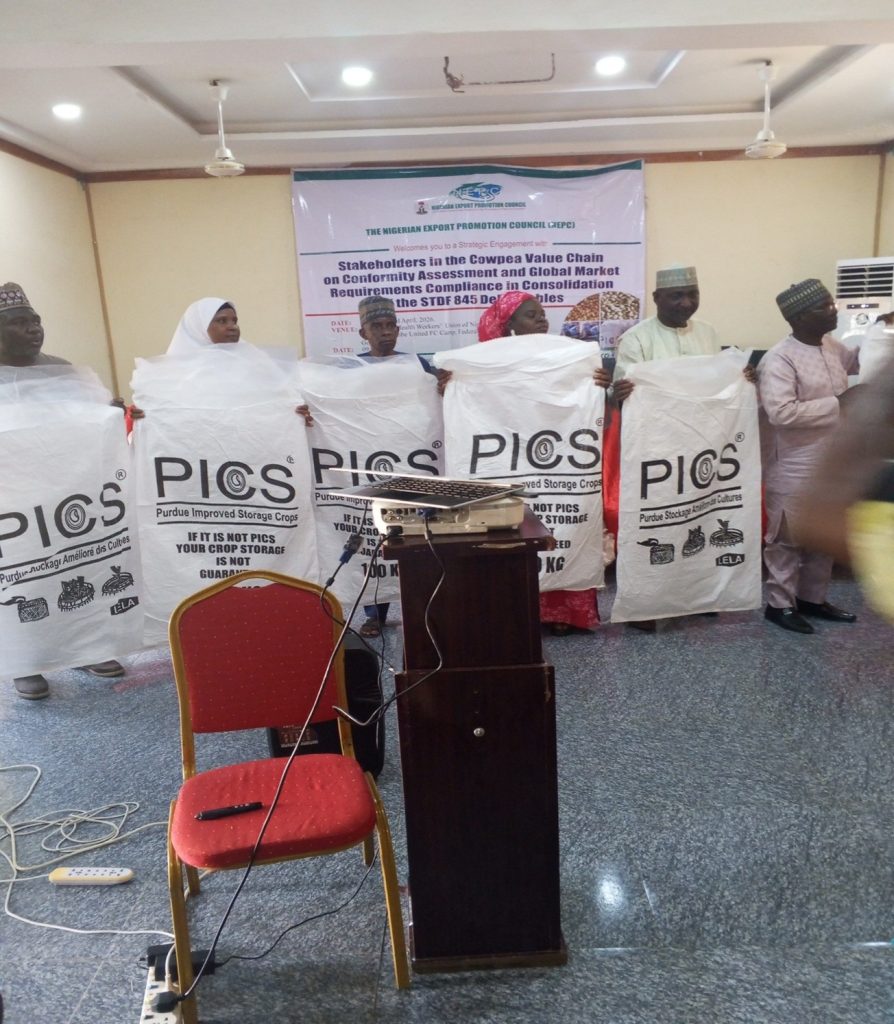
Speaking at the event, the State Coordinator of NEPC in Gombe, Mr. A. L. Bakin Kasuwa, described the workshop as timely, noting that it followed an extensive assessment of all eleven local government areas in the state. He urged participants to actively engage with technical experts to improve yields and deepen their understanding of quality requirements for international markets.
You Might AlsoLike




Kasuwa emphasised that adherence to Good Agricultural Practice (GAP), Good Handling Practice (GHP), and Good Storage Practice (GSP) would significantly enhance product quality and facilitate access to global markets. He added that NEPC’s ongoing support initiatives are designed to position local producers for export opportunities.
In his keynote address, the Director of Product Development at NEPC Headquarters, Mr. Macpherson, highlighted persistent challenges affecting Nigerian cowpea exports, including excessive chemical residues, contamination, and non-compliance with international standards. He recalled that these issues led to a ban on Nigerian cowpea exports to the European Union since 2015, resulting in substantial economic losses.
He stressed the importance of adopting global best practices to reverse the trend, noting that the engagement was critical not only for export promotion but also for strengthening primary production, value addition, processing, and manufacturing within the sector.

As part of efforts to improve storage standards, the NEPC distributed sample storage bags to participants. The initiative is expected to support farmers in adopting safer storage methods and eliminating the use of harmful chemicals and unhygienic practices, which have posed health risks in some communities.
In his remarks, the RMRDC State Coordinator in Gombe, Engr. Abdullahi G. D., underscored the Council’s commitment to promoting value addition in raw materials. He noted that enhancing value addition in the cowpea value chain would increase profit margins for producers, create jobs, support economic diversification, and conserve foreign exchange.
According to him, RMRDC is working towards achieving at least 30 per cent value addition to primary raw materials before export, in line with the national strategy for competitiveness in raw materials and product development.
The workshop featured technical sessions focused on conformity assessment in cowpea production, processing, and handling, guided by GAP, GHP, and GSP standards. A second session examined compliance requirements for accessing global markets, providing participants with practical insights into export readiness.
Stakeholders at the event expressed optimism that the collaboration between RMRDC and NEPC would significantly improve the quality and global competitiveness of Nigerian cowpea, particularly from Gombe State, which remains a major production hub in the country.