
By Yakub Raheemat & Yelwa Adam Shuaib
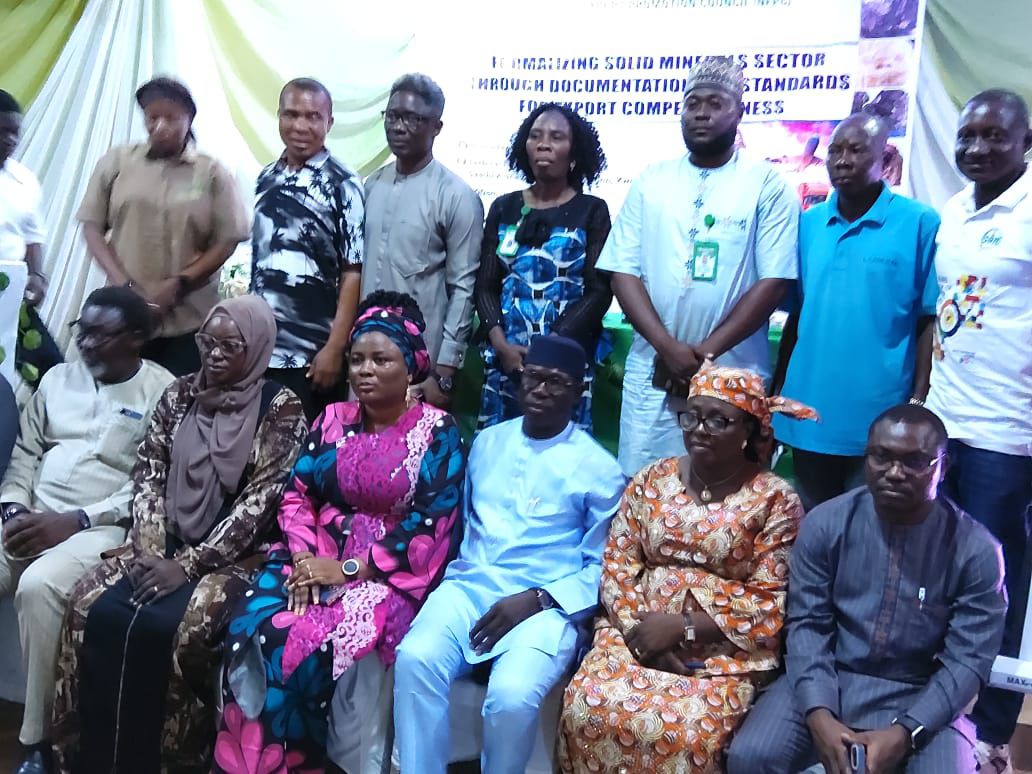
The Kwara State Coordinating Office of the Raw Materials Research and Development Council (RMRDC) participated in a high-level technical workshop convened by the Nigerian Export Promotion Council (NEPC) to advance regulatory compliance and export readiness in Nigeria’s solid minerals sector.

The one-day workshop, held on April 16, 2026, at the Federal Establishment Forum Hall in Ilorin, focused on standardisation, documentation, and traceability as critical enablers of export competitiveness. It brought together representatives from key regulatory institutions, financial bodies, and industry associations to address structural gaps limiting the sector’s integration into formal export markets.
Participants included officials from the Standards Organisation of Nigeria (SON), Bank of Industry (BOI), Kwara State Ministry of Solid Minerals Development, the Miners Association of Nigeria, and Women in Mining in Nigeria, alongside senior government functionaries, including the Honourable Commissioner for Commerce.
Presenting on behalf of the NEPC Chief Executive Officer, the Director of Solid Minerals, Mr. Jaja Toju Mac, outlined procedural requirements for mineral exports, with emphasis on corporate registration, contract integrity, and adherence to extant export regulations. He also highlighted Nigeria’s resource base, comprising over 44 commercially viable minerals across the federation, and reiterated the Federal Government’s export expansion targets for 2030.
You Might AlsoLike




Kwara State’s mineral endowment, including lithium, gold, gypsum, quartz, iron ore, tantalite, kyanite, and tourmaline, was identified as a strategic asset for both domestic industrialisation and foreign exchange earnings, provided value chains are formalised and aligned with international standards.
In a technical session on quality infrastructure, the Standards Organisation of Nigeria detailed compliance protocols, including certification requirements, packaging and labelling standards, and restrictions on the export of controlled materials such as uranium and unprocessed metal scrap.
The RMRDC State Coordinator, Mrs. Adewumi, clarified institutional roles within the export ecosystem, noting that NEPC oversees export certification and compliance for outbound commodities, while RMRDC drives value addition and industrial processing of raw materials to enhance export quality and market acceptability.

The Bank of Industry outlined financing windows tailored to mining enterprises, with particular focus on supporting beneficiation and downstream processing to improve product value prior to export.
The event ended with deliberations on a consensus, strengthening inter-agency coordination, formalising artisanal and small-scale mining operations, and enforcing compliance frameworks to curb illegal mining and optimise the economic returns from Nigeria’s mineral resources.