Halima Olufadi and Asma’u Nasiru
The Raw Materials Research and Development Council (RMRDC), through its Raw Materials Cluster Development Division (RMCDD), has recently held a one-day capacity building programme aimed at strengthening staff knowledge on cluster development and its role in achieving the Council’s mandate. The training took place at the RMRDC Headquarters in Abuja.

The capacity building programme forms part of the Council’s ongoing efforts to deepen staff understanding of cluster driven industrial development as it enhances the Council’s ability to drive value addition, support local manufacturing, and facilitate smoother implementation of development projects across Nigeria’s raw materials sector.
Declaring the workshop open on behalf of the DG/CEO Prof. Nnanyelugo M. Ike-Muonso, the Director, Raw Materials Cluster Development Division, Mrs. Rebecca Nnamdi-Anum, stated that the programme was designed to broaden staff capacity in line with the Council’s drive for sustainable raw materials development. She noted that enhanced understanding of cluster development would help staff support value addition, deepen industrial linkages, and improve the competitiveness of local industries.
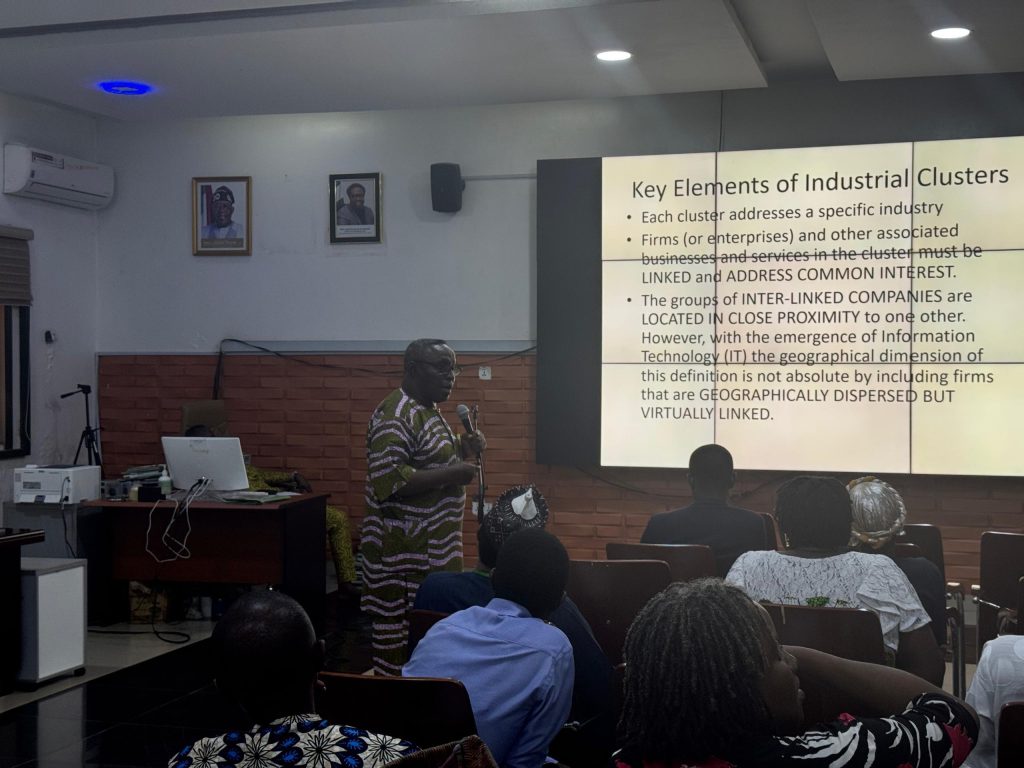
The knowledge-sharing session featured three technical presentations delivered by seasoned resource persons from within the Council.
You Might AlsoLike




The first paper, titled “Understanding RMRDC Mandates and the Strategic Role of RMCDD,” was presented by Deputy Director, Plant and Equipment Management Division (PEMD), Engr. Obassi Ettu. He traced Nigeria’s economic history trajectory from the pre-independence era to the present day, highlighting the gaps that led to the establishment of RMRDC. He also provided an overview of cluster development and explained its strategic importance to industrialization and raw materials value chain growth.
Engr. Obassi also highlighted several bold initiatives introduced under the current Director-General/CEO to strengthen the Council’s mandate delivery. These include the initiation of the 30% Value Addition Bill with extensive tariff incentives, the establishment of the RMRDC database e-portal, and the introduction of the annual African Raw Materials Summit. He noted the development of a 10-year raw materials roadmap in partnership with development institutions, the enhancement of the Council’s visibility through the Raw Materials 360 online platform, and ongoing efforts to set up modern state-of-the-art laboratories for characterization and standardization. According to him, the period has also witnessed major restructuring of the Council’s organizational framework, unprecedented staff training and capacity building, and notable improvements in staff welfare and overall corporate performance.
In the second presentation, Dr. Hajara Tanko spoke on “Operationalizing RMCDD Functions.” She underscored the impact of well-structured clusters in pulling small businesses out of isolation and integrating them into strong, competitive networks. According to her, collaboration within clusters strengthens supply chains, enhances product competitiveness both locally and internationally, and directly aligns with the Council’s vision of becoming an indispensable catalyst for Nigeria’s industrial growth.

Dr. Hajara further explained that establishing raw materials clusters directly supports the Council’s mission of “optimal utilisation.” She noted that clusters enable businesses to work together, minimise waste, share resources, and increase value addition within Nigeria. According to her, this cooperation makes clusters an effective tool for ensuring that the nation’s raw materials are used more efficiently and productively across the value chain.
The final paper was delivered by Dr. Seb Obassi on “Driving High-Impact Cluster Projects.” He identified the key elements required for effective cluster development, stressing that the most critical factor is the strength of linkages among enterprises engaged in related economic activities regardless of their physical location. Dr. Obassi also noted that the proposed 30 Percent Value Addition Bill, currently awaiting Presidential assent, would significantly boost cluster growth and enhance industrial productivity across the value chain.
He further broke down the practical steps involved in transforming scattered business “clumps” into fully developed innovation clusters. He said the process starts with identifying the type of cluster the country needs most, whether raw material based or product-focused, guided by market potential and national priorities. He emphasized the importance of choosing locations with existing advantages such as available enterprises, raw materials, and nearby knowledge institutions to ensure quicker results. According to him, targeting these naturally advantageous areas, often referred to as “low-hanging fruit,” reduces costs and accelerates the successful emergence of innovation clusters.
The training also included a question-and-answer session, which helped participants better understand the role of clusters in industrial development and further showed the Council’s commitment to building staff capacity to carry out its mandate.