By Adaora Adibe and Nafisat Abdulraham
The Raw Materials Research and Development Council (RMRDC) on January 15, 2026, continued its tradition of thought leadership with another edition of its Lecture Series, a platform designed to interrogate critical constraints facing Nigeria’s industrial and economic development. The event took place at the RMRDC Board Room in Abuja and was virtually showcased via live Youtube broadcast.

The lecture examined a question central to Nigeria’s development paradox: why abundance in natural resources has not translated into stable supply, industrial growth and price stability.
Anchoring this edition was the Director of the Agricultural and Agro-Allied Department (AAD), RMRDC, Dr. Sab Ebiriekwe, who delivered a lecture titled “Case Studies on Successful Inventory Optimization in Nigeria’s Agro and Solid Mineral Sectors.” His presentation shifted attention away from production volumes to a less visible but more decisive factor, inventory reliability.
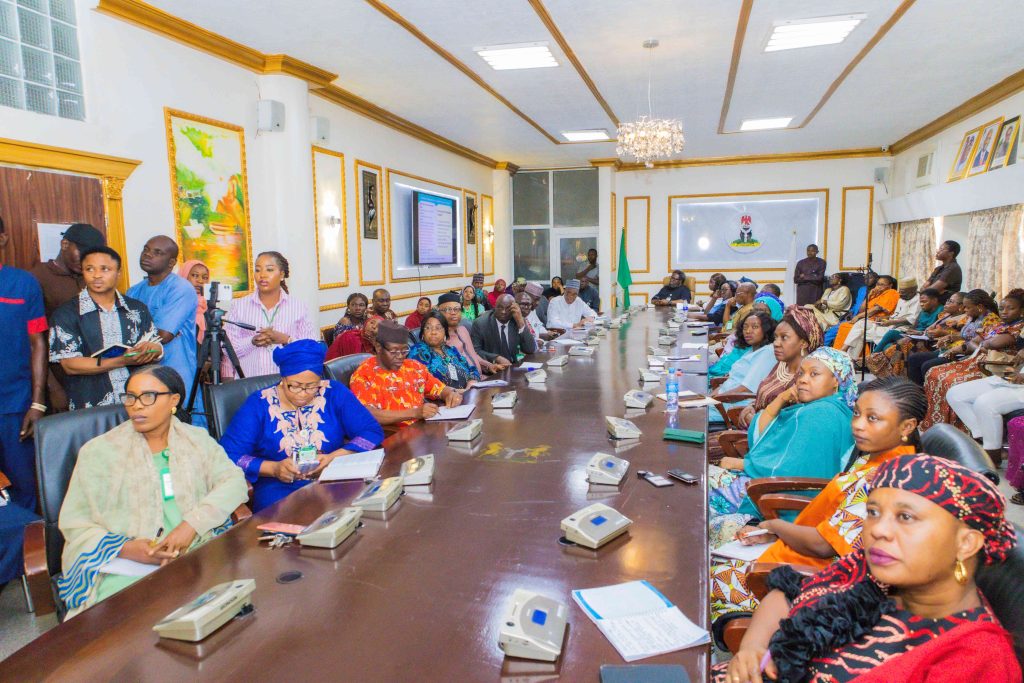
Dr. Ebiriekwe framed the lecture within the broader objective of the RMRDC Lecture Series: to provide evidence-based insights that connect raw materials development to industrial performance. He noted that Nigeria’s challenge is not a lack of resources, but a systemic inability to convert output from farms and mines into dependable, certified and continuously available supply.
You Might AlsoLike




Nigeria, he reminded the audience, is Africa’s largest producer of cassava, yam and several major cereals, while also possessing large deposits of limestone, gypsum, barite, kaolin and feldspar. Yet the country continues to experience food inflation, factory shutdowns and heavy dependence on imported industrial inputs.
“The decisive factor between resource abundance and national competitiveness,” Dr. Ebiriekwe said, “is not how much a country produces, but how reliably it can store, certify, track and release what it produces.”
Inventory Failure as a Structural Constraint

The lecture identified systematic inventory failure as a major structural problem across both agriculture and solid minerals. In the agricultural sector, post-harvest losses of between 30 and 45 per cent were attributed to poor storage, weak aggregation and delayed market access. In the solid minerals sector, losses arise from contamination, weathering, lack of beneficiation and the absence of certified stockpiles.
Beyond physical losses, Dr. Ebiriekwe highlighted critical gaps in quality assurance and certification, noting that inconsistent grading standards make it difficult for industries to rely on locally sourced raw materials. Equally damaging is the lack of inventory visibility, with no real-time national data on stock volumes, grades or locations, and weak linkage between supply and demand planning.
Case Studies from Farms, Warehouses and Mines
True to the lecture’s theme, Dr. Ebiriekwe grounded his analysis in real-life Nigerian case studies, drawing lessons from farms, agro-processing warehouses and mining operations where improved storage, tracking and quality control had reduced waste, stabilized supply and lowered costs.
He explained that inventory optimization, defined as having the right quantity and quality of stock, at the right place and time, at the lowest total cost, relies on practical tools such as aggregation, preservation infrastructure, laboratory grading, digital record-keeping and demand-linked release systems.
These interventions, he noted, transform crops and minerals into continuous, quality-assured industrial feedstock, while supporting food sufficiency, price stability and foreign exchange savings.
Firm-Level Efficiency, National-Level Impact
The lecture distinguished between firm-level and national-level inventory optimization. At the firm level, effective inventory management helps farms, processors and mining companies avoid production stoppages, reduce spoilage, minimize logistics costs and maintain steady supply to customers.
At the national level, optimized inventory supports food security, stabilizes prices, reduces post-harvest and post-extraction losses, enables import substitution and provides strategic reserves for emergencies and export reliability.
“Inventory is the system break-point,” Dr. Ebiriekwe stressed. “It is where production becomes usable supply and where surplus can either become stability or scarcity.”
RMRDC’s Strategic Role
A key takeaway from the lecture was the strategic positioning of RMRDC in addressing Nigeria’s inventory challenge. Dr. Ebiriekwe argued that, by statutory mandate and cross-sectoral reach, the Council is well placed to coordinate a National Inventory Operating System that links production, storage, quality certification, digital visibility and demand forecasting.
Such a system, he said, would close Nigeria’s “resource reliability gap” and convert natural endowment into dependable supply for industries, markets and exports.
The Director-General, RMRDC, Prof. Nnanyelugo Ike-Muonso noted that the lecture had reinforced the urgent need for the Council to strengthen its institutional focus on inventory management, pointing out that the establishment of an Inventory Division within RMRDC is already captured in one of the Council’s statutory mandates; “Review from time to time, raw materials availability and utilization with a view of advising the Federal government on strategic implication of depletion, conservation and stockpiling of such resources.”
According to him, effective inventory coordination remains a missing link in Nigeria’s efforts to translate raw material abundance into dependable industrial supply.
Professor Ike-Muonso emphasized that placing inventory optimization at the centre of industrial policy is critical to achieving food security, sustaining industrial operations and reducing the country’s reliance on imports. He added that without reliable, certified and visible inventories, production gains would continue to be undermined by losses, shortages and price instability.
He concluded that the lecture had once again demonstrated the strategic value of the RMRDC Lecture Series as a platform for generating practical, solution-oriented ideas capable of transforming Nigeria’s natural resource wealth into sustained economic resilience and industrial competitiveness.