By Adejare Ibrahim and Ajayi Olamide
In a renewed push to boost Nigeria’s non-oil export base and enhance the global competitiveness of its agricultural produce, the Raw Materials Research and Development Council (RMRDC), Oyo State Coordinating Office, has reaffirmed its commitment to driving quality standards within the nation’s cashew industry. This came as the Council actively participated in the National Quality Policy (NQP) Implementation Matrix Sector-Specific Workshop on Cashew, held from 8th to 11th September 2025at the Vigna, International Institute of Tropical Agriculture (IITA), Moniya, Ibadan.

Organised by the Nigerian Quality Council (NQC) in collaboration with the British Standards Institution (BSI), the four-day workshop convened critical stakeholders across the cashew value chain, including producers, processors, exporters, researchers, and policymakers, to deliberate on strengthening the nation’s cashew industry and promoting strategic role in diversifying Nigeria’s economy and increasing export value. Despite being one of the world’s leading producers of raw cashew nuts, Nigeria continues to face challenges such as inadequate value addition, limited access to accredited laboratories, weak conformity assessment, and low awareness of international quality standards. The goal is to align Nigeria’s cashew products with international best practices, ensure compliance with export standards, and unlock the full economic potential of the sector.
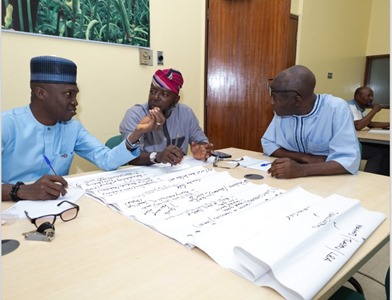
Representing RMRDC at the event, the Oyo State Coordinator, Mr. O. A. Adeogun, emphasised the importance of research, innovation, and quality assurance as key drivers of industrial growth, reiterating its resolve to champion initiatives that would position Nigeria as a global leader in cashew production and processing. He stated that the Council plays critical role of providing technical and investment information to support the development of the cashew industry, thereby ensuring effective linkage between research, industry, and policy. He noted that “RMRDC remains committed to strengthening Nigeria’s agricultural value chains through innovation, industrial collaboration, and strategic partnerships that promote quality and competitiveness.”
Participants engaged in technical presentations, group discussions, and value stream mapping exercises, identifying bottlenecks across the production, processing, and export stages of the cashew value chain. The sessions highlighted the need for investment in accredited laboratories, harmonisation of local standards with ISO and Codex Alimentarius, improved farmer training on Good Agricultural Practices (GAP), and the development of a national traceability system for cashew exports. The Council contributed to discussions on promoting local processing, developing quality infrastructure, and encouraging investment through public-private partnerships.
You Might AlsoLike




Key outcomes from the workshop included:
- Agreement to review and update national cashew standards to align with global benchmarks.
- Commitment to upgrade laboratories for aflatoxin and pesticide residue testing.
- Introduction of digital traceability systems to enhance transparency in the value chain.
- Strengthened collaboration among government agencies, farmers, processors, and exporters.
- Enhanced stakeholder capacity for compliance with international market requirements.
The event concluded with a communiqué outlining next steps for implementing the NQP in the cashew sector. Participants reaffirmed their commitment to embedding quality across the value chain covering production, processing, certification, and export. The workshop reinforced the collective vision of transforming Nigeria’s cashew industry into a globally competitive and quality-driven sector, while positioning the NQP as a practical framework for achieving industrial excellence.
The RMRDC continues to demonstrate leadership in promoting raw materials development, industrial diversification, and quality assurance, contributing to Nigeria’s goal of achieving sustainable economic growth through innovation and global best practices.