By Azi Stella, Obot Festus & Adibe Adaora
In line with President Bola Tinubu’s Nigeria First Policy, the Manufacturers Association of Nigeria (MAN) and the Raw Materials Research and Development Council (RMRDC) have demonstrated practical commitment to reposition Nigeria’s manufacturing sector to stimulate sustainable economic growth and industrial development. Speaking at the 8th Nigeria Manufacturing Equipment (NME) colocated with the 9th Nigeria Raw Materials (NIRAM) Expo 2025 in Lagos which had as its theme: “Accelerating Sustainable Manufacturing Through Cutting-edge Equipment and Technology Solutions”, the President of MAN, Otunba Francis Mesioye stated that “the Expo offers local fabricators, industrialists, original equipment manufacturers, inventors, raw materials researchers and producers a unique opportunity to re-examine the state of the manufacturing sector and to co-create solutions to ameliorate identified challenges.

Otunba Francis Mesioye further emphasized that “by embracing cutting-edge technology solutions, we are accelerating innovation, resilience and long-term value for our stakeholders”. “Our focus is to spark conversations around the deployment of energy-efficiency in production processes; implementation of smart factory protocols, including Internet of Things (IoT) and Artificial Intelligence (AI) to optimize resource use; adopt waste reduction strategies through closed-loop systems and advanced recycling methods”, he stated further.
In his address to participants at the NME/NIRAM Expo, the Director General of the Raw Materials Research and Development Council (RMRDC), Prof Nnanyelugo Ike-Muonso drew attention to the huge foreign exchange expended on importation of raw materials. He lamented that Nigeria spent a whooping N4.53 trillion naira (about $11bn) within the first nine months of 2024. This figure represents a staggering 119% surge from the previous year’s record and should not be allowed to persist.
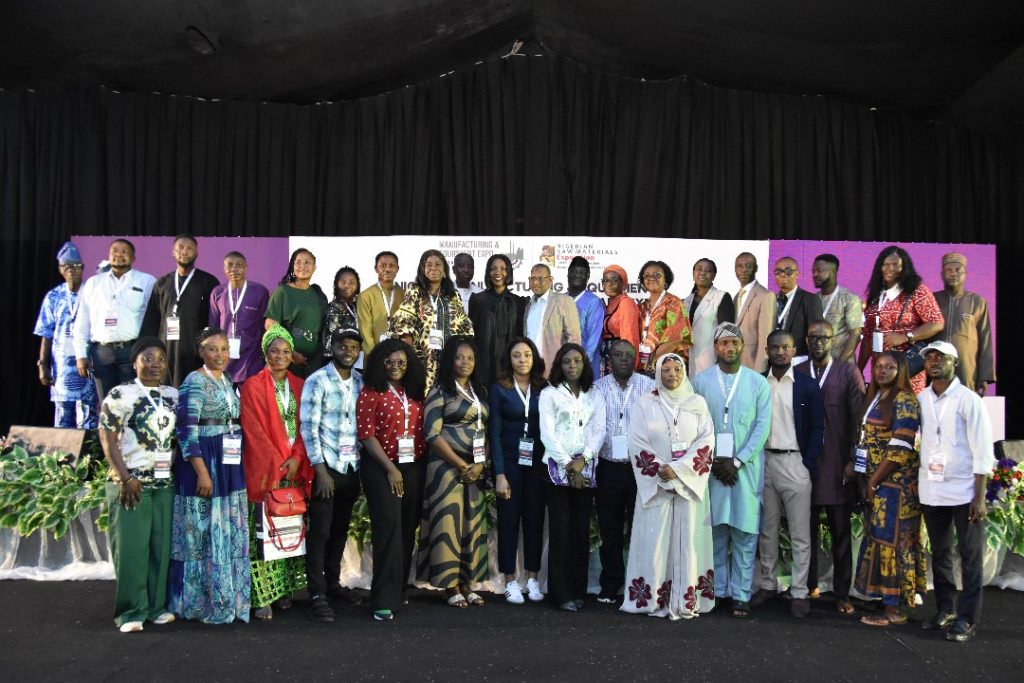
Prof Ike-Muonso stressed that with over 120 commercially viable solid minerals, vast agricultural resources and a demographic dividend of youthful population should not have any business expending huge foreign exchange importing raw materials. He described the NME/NIRAM Expo as a melting point to trigger strategic coordination, bold implementation, and technology-backed commitment. Prof. Ike-Muonso further informed participants that the Federal Government has given RMRDC the authority to implement significant tax-incentive guidelines aimed at rewarding manufacturers and innovators using locally sourced inputs in their production processes. Speaking further, Prof Ike-Muonso affirmed that the landmark approach by the Federal Government demonstrates President Bola Tinubu’s determination to achieve sustainable economic growth and industrial development through empowering the manufacturing sector in Nigeria. “This landmark approval entitles compliant firms in agro-processing, pharmaceuticals, polymers, fabric, green tech, and so on, tax credits, duty reliefs, investment allowances, and excuse waivers”, he stated.
You Might AlsoLike




The RMRDC Director General stated that the Council was already taking proactive and deliberate steps to fully align its projects and programmes with Mr President’s ‘Nigeria First Policy’ direction. Highlighting some of the laudable steps taken by RMRDC in this direction, the DG said, “at the RMRDC, this year’s NME/NIRAM theme find its truest embodiment in our recently commissioned Research and Demonstration Plant Complex (RDPC), which is the nerve centre of national industrial reawakening. This Complex showcases more than 50 locally designed and fabricated pilot plants comprising among others, machinery for turning cassava into sorbitol, talc into pharmaceutical-grade powder, Shea into essential oils, and so much more”. He invited participants to pay a visit to the Council’s RDPC and witness how each reverse-engineered or painstakingly home-built process equipment is proof that Nigeria can transform raw materials into real wealth.
The 3-day NME/NIRAM Expo witnessed colourful exhibitions from manufacturers, innovators and inventors utilizing local inputs as their major raw materials.