By Stella Azi and Adaora Adibe
The Minister of Innovation, Science and Technology, Honourable Kingsley Tochukwu Ude, has called for the global projection and commercialization of the achievements of the Raw Materials Research and Development Council (RMRDC), following his visit to the Council’s Research Demonstration Plant Complex (RDPC) in Abuja.

The Minister, who toured the facility located within the National Space Research and Development Agency (NASRDA) premises, expressed satisfaction with the level of innovation and technological advancement on display, describing the Council’s work as impressive and worthy of international recognition.

“My expectation has been exceeded,” Ude said during the tour. “What we will do going forward is to ensure that we take the good work we are doing to the international stage. Enough of just doing this effort and it remains here. We should upscale them and meet the needs across various sectors.”
He emphasized the need to move beyond research to commercialization, noting that Nigeria must begin to showcase its scientific and industrial capabilities to the global community while leveraging them for economic growth. The Minister also directed that a commercialization committee be set up immediately to drive the process of scaling up the Council’s innovations and attracting investment.
You Might AlsoLike




Describing the visit as a preliminary assessment, Ude said the outcomes would inform broader efforts to present the Council’s achievements to the public and international stakeholders. He further called for optimization of existing pilot plants and stronger partnerships with relevant stakeholders to accelerate industrial application.
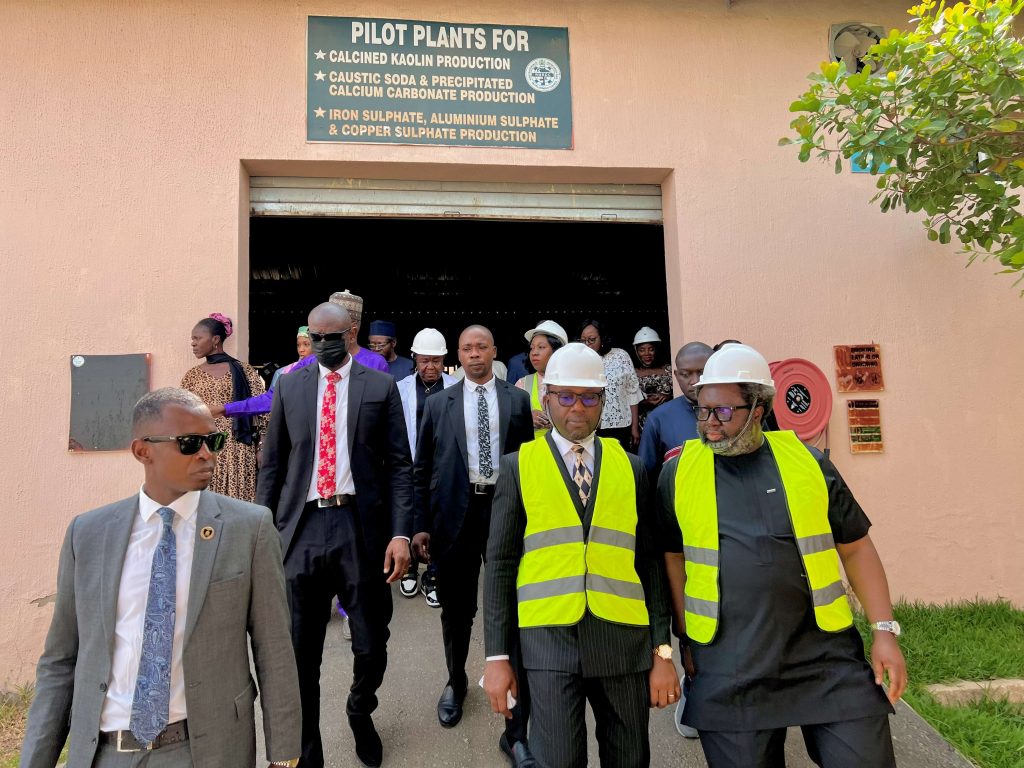
During the tour, the Minister inspected several pilot plants, including Water Borne Paint, Soap Noodles, Caustic Soda, Calcined Kaolin, Pharmaceutical Grade Talc, Lovastatin, Artemisinin Active Pharmaceutical Ingredient (API) from Artemisia annua, Skin Care, Castor Processing and Plaster of Paris (POP), as well as the Council’s fabrication workshop.
The Director-General and Chief Executive Officer of RMRDC, Professor Nnanyelugo Ike-Muonso, who led the Minister and his team, explained that the pilot plants and equipment were designed and fabricated locally within the RDPC. He noted that the Council has made significant progress in developing indigenous technologies that can support Nigeria’s industrialization drive.

Highlighting one of the Council’s products, the Director-General stated that RMRDC produces high-quality Plaster of Paris using locally sourced raw materials and fabricated machinery. He added that the product is cost-effective for local industries and has applications in orthopedics, among other uses. He reiterated that commercialization and collaboration with the private sector remain central to the Council’s strategic agenda.

Also speaking, the Director (RDPC), Dr. Obiageli Okafor, said most of the pilot plants are functional and ready for commercialization, stressing that the Council is prepared to transition from research to full-scale industrial production.
On the pharmaceutical front, the Deputy Director, Pharmaceutical Division, Engr. Uche Mmaduegbunam, highlighted the Council’s advancements in mushroom cultivation and Lovastatin production. She explained that RMRDC has successfully conducted research and achieved high-yield outputs, noting that the products are now at pilot stage and ready for commercialization.
Similarly, Engr. Sirajo Musa, Deputy Director in Pilot Plant and Process Equipment Division, disclosed that the Council has recorded breakthroughs in the production of Artemisinin, a key ingredient in malaria treatment. He explained that the Council introduced Artemisia annua seeds into Nigeria and developed locally fabricated machines capable of producing up to 500 kilograms per day. According to him, the plant thrives across two seasons in Nigeria, compared to one season in Vietnam, with a high concentration level of about ninety six percent.
Assistant Director, Engineering Fabrication workshop Division (EFWD) Engr. Raheem Dauda Mokolade, further confirmed that most of the pilot plants used in the facility are locally fabricated to standard, underscoring the Council’s commitment to indigenous engineering and technological development.
The Minister also visited the Tropics Derma Research and Training Institute, where ongoing collaboration with RMRDC on skincare innovation was showcased. The founder of the institute, Dr. Edith Gibson, disclosed that the partnership, which began in 2024, has involved extensive research based on over 40,000 skin samples collected across the 36 states of the federation.

She explained that the research aims to develop skincare products tailored to Nigeria’s diverse population and climatic conditions, noting that the country currently imports over 40 percent of its skincare products. According to her, the institute is working on producing emulsifiers from local raw materials such as shea butter, with the goal of creating globally competitive products using advanced delivery systems, including nanotechnology.
Gibson added that some of the research outputs are already attracting investor interest, as efforts intensify to transition from laboratory research to full commercialization. She emphasized the institute’s vision to pioneer tropical skincare solutions using Nigerian raw materials.
Responding, the Minister reiterated the importance of moving beyond research to commercialization, urging the institute to develop a position paper to guide policy and investment decisions. He identified pharmaceuticals, chemicals and cosmetics as key industries that should be prioritized in the commercialization drive.
Ude reaffirmed the Federal Government’s commitment to supporting innovation-driven industrial growth, stressing that institutions like RMRDC must play a leading role in transforming research outcomes into market-ready products that can compete globally.