By Otoikhila Emmanuel
The Edo State Coordinating Office of the Raw Materials Research and Development Council (RMRDC), in collaboration with the Department of Forestry, Faculty of Agriculture, University of Benin, and the Division of Food and Beverage, RMRDC Headquarters, has carried out a comprehensive survey on Thaumatococcus daniellii across eighteen local government areas of Edo State.

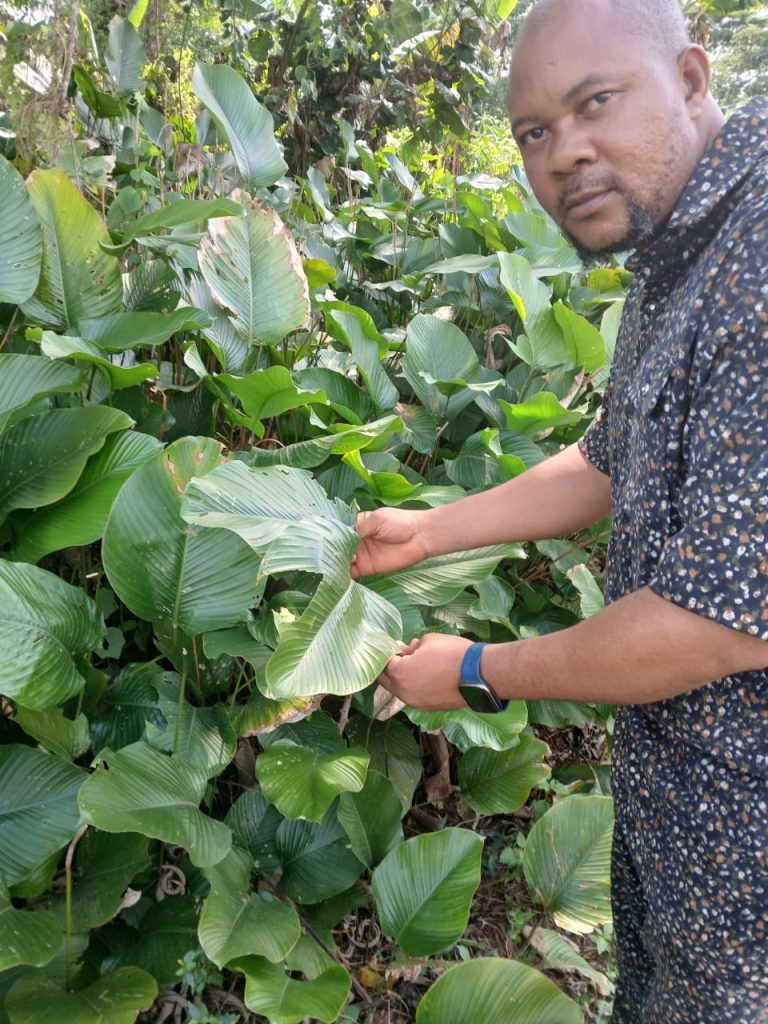
The two-day survey, conducted on February 13 and 14, 2026, was aimed at identifying the local government areas and precise geographical coordinates where Thaumatococcus daniellii can be found growing in the wild. The plant, commonly known in English as sweet prayer plant, miracle fruit, or Africa serendipity berry, is locally called “Asebi” in Edo State.
Findings from the survey revealed the presence of the plant in two major wild rainforest locations within the Sakponba axis. The first location was identified in Iguemokhua community, Ikpoba-Okha Local Government Area, with coordinates 6°06’73.0″N, 5°85’13.28″E. The second site was discovered in Iguobazuwa community, Ovia South-West Local Government Area, with coordinates 6°34’02″N, 5°16’12″E.
The survey team was led by the State Coordinator of RMRDC, Engr. Otoikhila Emmanuel , alongside Prof. Mathew Isikhume of the Department of Forestry, University of Benin; Mr. Caleb Avo Evinemi of the Division of Food and Beverage, RMRDC Headquarters; and Mr. Omoba Solomon, a Ph.D. researcher specializing in Thaumatococcus daniellii at the University of Benin.
You Might AlsoLike





According to Engr. Otoikhila, Thaumatococcus daniellii is a West African plant widely known as katemfe or miracle fruit. It produces thaumatin, an intensely sweet protein found in the fleshy red aril surrounding its seeds. Thaumatin is estimated to be 2,000 to 3,000 times sweeter than sucrose and is used globally as a natural, low-calorie sweetener.
He observed that, botanically, the plant is a large, rhizomatous perennial herb characterized by broad, papery leaves and crimson fruits that grow at its base. It thrives in tropical rainforests and holds significant economic and cultural value in its native regions.
“Beyond its sweetening properties, the plant has diverse traditional uses. Its large leaves are commonly used for wrapping food, imparting a distinctive flavour and extending shelf life. The sturdy leaf petioles are woven into mats, baskets, and other household tools. In folk medicine, various parts of the plant are used in the treatment of ailments such as high blood sugar, mental disorders, and as antidotes for snake venom and bee stings, “he stated.

The team noted that the survey represents a critical step toward harnessing the economic potential of Thaumatococcus daniellii in Edo State. By mapping its natural habitats and documenting its distribution, stakeholders aim to promote sustainable harvesting, encourage cultivation, and explore industrial applications of the plant, particularly in the food and beverage sector.
The collaborating institutions expressed optimism that the findings will support further research, value-chain development, and possible commercialization initiatives that could enhance livelihoods and contribute to the state’s agricultural and industrial growth.