By Polycarp Datugun
The Plateau State Ministry of Commerce and Industry, in collaboration with the Nigerian Export Promotion Council (NEPC), held the third-quarter meeting of the State Committee on Export Promotion (SCEP) to deepen the implementation of the “One State One Product” (OSOP) initiative. The high-level engagement brought together government officials, private sector actors, and critical stakeholders, including the Raw Materials Research Development Council (RMRDC), to drive non-oil export development in the state using cluster and cooperative models.

The event held at the Cabinet Office Conference Hall in Jos, was focused on leveraging Plateau’s comparative advantage in horticulture, Irish potato, and other unique products to position the state competitively in Nigeria’s non-oil export landscape.
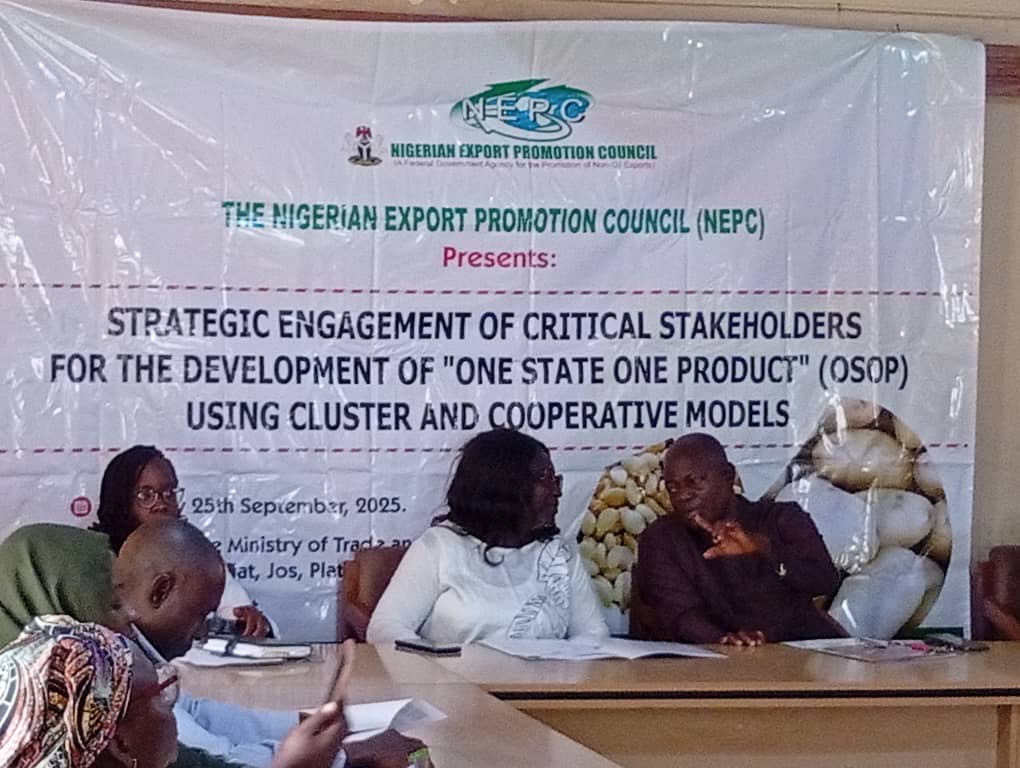
In his welcome address, the Hon. Commissioner for Commerce and Industry, Hon. Muhammed S. Nyalum, reaffirmed the state’s commitment to enhancing export capacity through policy, infrastructure, and stakeholder collaboration. He praised the success of the recent Coffee Festival organised by RMRDC in partnership with NACOFTAN and stressed the importance of organizing producers into clusters to improve export readiness. He charged participants to make actionable recommendations that will strengthen the state’s export ecosystem.
Delivering the keynote on behalf of the Executive Director/CEO of NEPC, Mr. John Okorie described the forum as a vital platform to align state and national export strategies. He highlighted the importance of value addition and the role of cooperative models in building a globally competitive non-oil export sector. Mr. Okorie encouraged Plateau stakeholders to capitalize on the state’s abundant horticultural resources and position products for international markets.
You Might AlsoLike

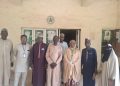

Permanent Secretary of the Ministry, Engr. (Hon.) Albert Chaimang, endorsed earlier remarks and called for improved documentation of meeting proceedings. He urged the committee to maintain proper formatting of reports and attach attendance records for transparency.
During the engagement, the RMRDC, represented by the Plateau State Coordinator, Mrs. Salifatu R. Guruza, joined other critical stakeholders in emphasizing the need for value addition before export. She strongly opposed the export of raw, unprocessed materials and encouraged entrepreneurs to process commodities locally to create jobs and increase foreign exchange earnings. RMRDC also highlighted a pending bill at the National Assembly seeking to mandate a minimum of 30% local value addition to raw materials before export.
Stakeholders were informed that the SCEP has ₦10 million allocated in the state budget, gives opportunities to access additional export financing through agencies like NAIC and NIRSAL

Shea nuts were identified as an underutilized resource in the southern region of the state, and participants called for renewed government attention in line with the federal ban on raw Shea nut export.
The issue of informal Irish potato export to neighbouring countries was raised, and the Commissioner acknowledged the lack of formal data, urging for structured tracking of such trade.
In a call to action, the NEPC representative advised the Plateau State Government to establish an Export Commodity Agency under the Ministry of Commerce and Industry to formalize trade and collaborate more effectively with NEPC. He also recommended regular representation of the state in national export promotion forums.