
Fa’izah Abubakar & Lilian Harrison
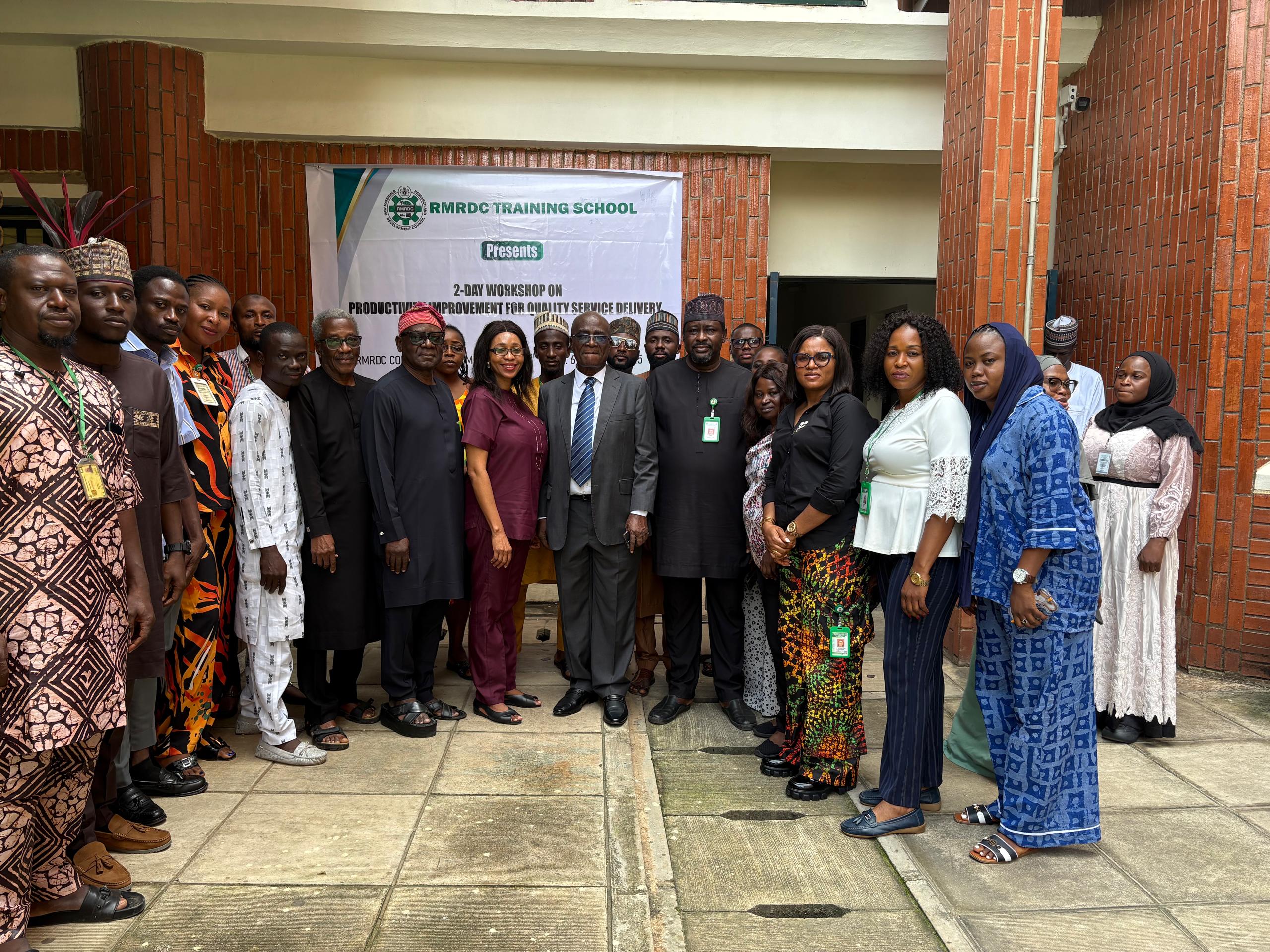
As part of efforts to improve staff efficiency and productivity, the Raw Material Research and Development Council (RMRDC) organised a 2-day workshop on “Productivity Improvement for Quality Service Delivery.”

The training, which was held in two batches from 5th to 6th and 12th to 13th of August, had different facilitators and participants selected from various departments at the Council’s headquarters in Abuja. The workshop was designed to enhance performance and build capacity for quality service delivery across the departments of the Council. It focused on equipping participants with practical tools, strategies, and insights to improve both personal and organizational productivity. Sessions addressed issues such as time and resource management, continuous improvement practices, and aligning daily tasks with the Council’s core goals and values.
Representing the Director-General, Prof. Nnanyelugo M. Ike-Muonso, the Dean, RMRDC Training School, Dr. Ify. C. Olife, in her opening remarks during the first batch of the training, stated that, “Productivity in a government agency is a measure of how efficiently and effectively the organization utilizes its resources to deliver public services and achieve policy objectives.”
Dr Olife emphasized that productivity is not measured by output alone but also by the impact created in society and the value added to the Council. She reminded participants that work carries its rewards and urged them to align with the Council’s ethics, values, and processes.
You Might AlsoLike




Dr. Olife further informed participants that the workshop was designed for value re-orientation to provide practical tools and insight to improve personal and organizational productivity. She noted that the workshop lectures would be handled by experienced resource persons who have distinguished careers as Directors in the public service and successfully translated their experiences into lucrative private practices.
During the first batch of the training, Mr. Babatunde Aluko highlighted that productivity is never an accident, but rather planned with targets and time as key factors. He charged participants to work towards meeting set goals with both elements in mind. He encouraged them to avoid distractions, create with their hearts, build with their minds, and make work fun and enjoyable. Mr Aluko stressed the importance of taking breaks to avoid burnout, noting that productivity distinguishes individuals and makes them relevant.
Similarly, Mr. F. K. Ode, who spoke on the mastery of productivity, said, “Time management is very important in productivity because once missed or misused, it cannot be replaced.” He encouraged participants to have a work-life balance, saying, “A better work-life balance leads to higher productivity. It also permits professionals to spend 20% of their time on personal passion projects.”

Also speaking to participants, Dr. Theresa Omara-Achong shared true-life experiences on the code of ethics with the participants. She listed some of the codes to include loyalty, honesty, courage, and justice, while encouraging staff to always be open to learn, unlearn, and relearn.
During the second batch of the training, Dr. (Mrs.) Jane Alagoa spoke extensively on the importance of measuring productivity and effective time management. She introduced participants to various productivity improvement tools and techniques aimed at strengthening teamwork and organizational collaboration. “It is not the amount of time, but the end result that matters,” she noted, while also sharing her personal experiences.
In the same vein, another resource person, Mr. Salisu Auwal Imam, delivered a paper on habit building and behavior. He stressed that emotional intelligence and self-awareness go hand-in-hand to ensure efficiency at work. He further highlighted strategies for behavioural change, such as goal setting and progress tracking.
Meanwhile, the Consultant, RMRDC Training School, Engr. Olushola Kayode, spoke on workspace optimisation, explaining that arranging office spaces effectively is essential for improving efficiency and productivity.