By Halima Olufadi, Nafisat Abdulrahman
To enhance institutional capacity and align with national industrial policy, the Raw Materials Research and Development Council (RMRDC) held a two-day strategic training for its officers on government fiscal policy and supplementary protection measures. The training, which was held from 8th to 9th of July, 2025 at the Council’s headquarters in Abuja, with the theme “Government Fiscal Policy Measures and Supplementary Protection Measures for Imports of Raw Materials and Products,”.

The training which was organized by the RMRDC Training School drew participants from various departments in the Council and was designed to deepen participants’ understanding of fiscal policies shaping Nigeria’s industrial landscape. The sessions covered key topics including fiscal policy impacts on raw material imports, regulatory compliance, strategic planning, and the implications of both the Supplementary Protection Measures (SPM) and the ECOWAS Common External Tariff (CET) on reducing imports and promoting local value addition. The programme featured pre- and post-assessment evaluations, expert lectures, and syndicate sessions with group presentations to foster practical engagement. It also included a syndicate session and group presentations to reinforce learning and practical application.
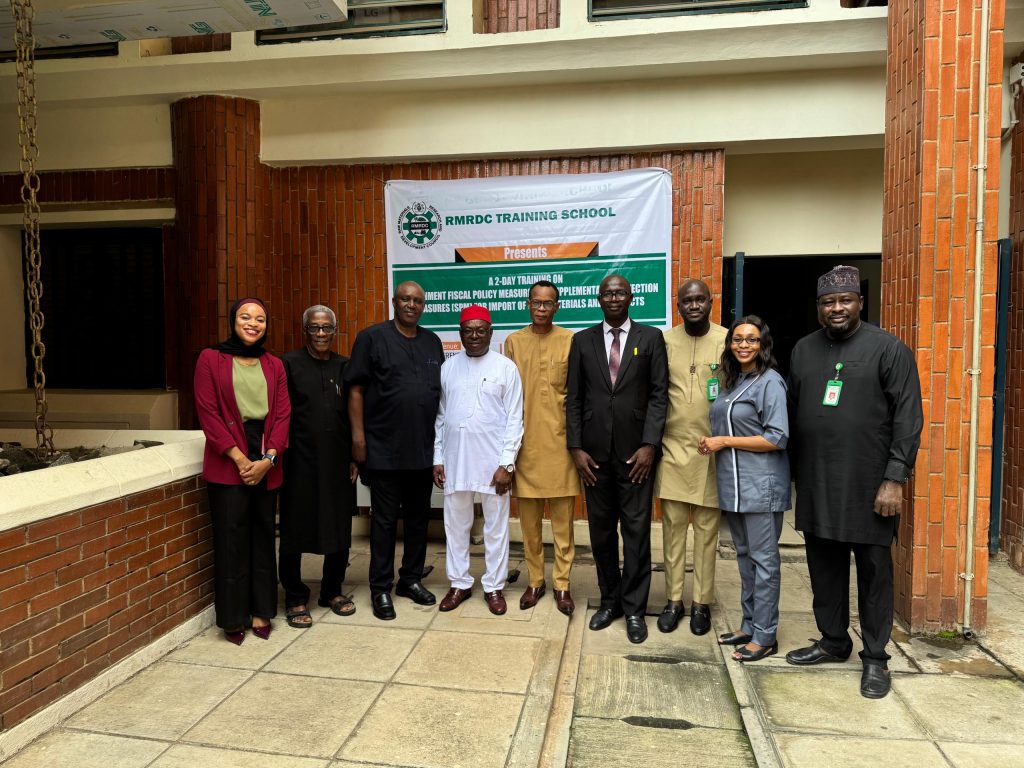
1st right: Asst. Director, Mr. Agwu Kama Onuogbu and the Dean of RMRDC Training School, Dr. I. C. Olife.
The Director-General of RMRDC, Prof. Nnanyelugo M. Ike-Muonso, commended the training initiative during a brief appearance, praising the facilitators and Training School for their efforts. He also provided updates on the progress of the 30% Value Addition Bill, which has passed the third reading in the Senate and is awaiting concurrence in the House of Representatives before heading to the Presidency for assent. He described the timing of the training as apt, given the potential implications of the bill on Council’s programmes and projects.
The Dean of the RMRDC Training School, Dr. I. C. Olife, earlier in her opening remarks, highlighted that Council’s mandates support industrialization through raw materials research and development. She stressed the need for staff to be conversant with policy tools that govern raw material utilization in Nigeria, adding that such fiscal instruments are crucial for advancing local industries. “Policy is the bridge between potential and progress. Knowing policy is power, and applying it is transformation,” she stated.
You Might AlsoLike




Mr. Abubakar S. Kollere, Director of the Chemicals and Pharmaceuticals Department and RMRDC’s representative on the Tariff Review Board, further tied the training to the Council’s strategic goals. He emphasized that once the 30% Value Addition Bill is enacted, it will expand RMRDC’s mandate, making initiatives like this training vital for preparing staff for greater responsibilities in driving local industrial growth.
The two-day training not only deepened participants’ understanding of fiscal measures affecting raw materials importation but also positioned them to play a more strategic role in advancing Nigeria’s industrial goals. By equipping its workforce with up-to-date policy knowledge and practical tools, RMRDC continues to reinforce its institutional relevance and readiness to lead in driving value addition, reducing import dependency, and supporting the nation’s long-term economic diversification agenda.