

By Nafisat Abdulrahman
The Director General and Chief Executive Officer of the Raw Materials Research and Development Council (RMRDC), Prof. Nnanyelugo Ike-Muonso, says the Council is repositioning Nigeria’s raw materials sector to accelerate industrialisation, attract investment and reduce dependence on the export of unprocessed raw materials.

Speaking during an interview on Voice of Nigeria’s programme In the News, Prof. Ike-Muonso said the Council had returned to its original mandate of ensuring the availability of industrial raw materials for local manufacturers through policies that promote value addition and import substitution.
He explained that RMRDC was established to bridge the gap between raw material extraction and industrial utilisation, noting that over the years the Council’s role had often been misunderstood.
A major step towards achieving the Council’s objective, he said, is the proposed legislation requiring a minimum of 30 per cent value addition before raw materials can be exported.
You Might AlsoLike



“The law will ensure that raw materials are not exported in their raw state without adding value. It will stimulate local processing, attract global investment, create jobs, transfer technology and reduce pressure on Nigeria’s foreign exchange,” he said.
The DG noted that the proposed legislation also seeks to discourage the importation of raw materials that are available in sufficient quantity and quality within the country.
On research and innovation, Ike-Muonso said the Council has produced nearly 600 research outcomes and about 47 patented innovations aimed at improving the development and utilisation of Nigeria’s raw materials.

He added that RMRDC’s Research and Demonstration Plant Complex continues to support the development of indigenous processing technologies and equipment that reduce dependence on imported machinery while facilitating the commercialisation of research outputs.
The DG also highlighted institutional reforms introduced since assuming office, including restructuring the Council’s operations, strengthening performance management systems and digitising internal processes.
According to him, these reforms contributed to the Council obtaining ISO 9001:2015 Quality Management System certification, making it one of the few government agencies to attain the international standard.
Speaking on collaboration, Prof. Ike-Muonso said collaboration has become a major pillar of the Council’s renewed strategy. He noted that RMRDC has strengthened engagement with the Manufacturers Association of Nigeria (MAN) to better serve local industries. The Council has also signed Memoranda of Understanding with about 46 universities to promote research and commercialisation, is expanding collaboration with state governments, and is partnering with the World Association of Industrial and Technological Research Organizations (WAITRO) to facilitate technology transfer and strengthen raw materials research and processing. He added that the Council is also working with private investors to commercialise research outcomes and develop products from Nigeria’s abundant raw materials.
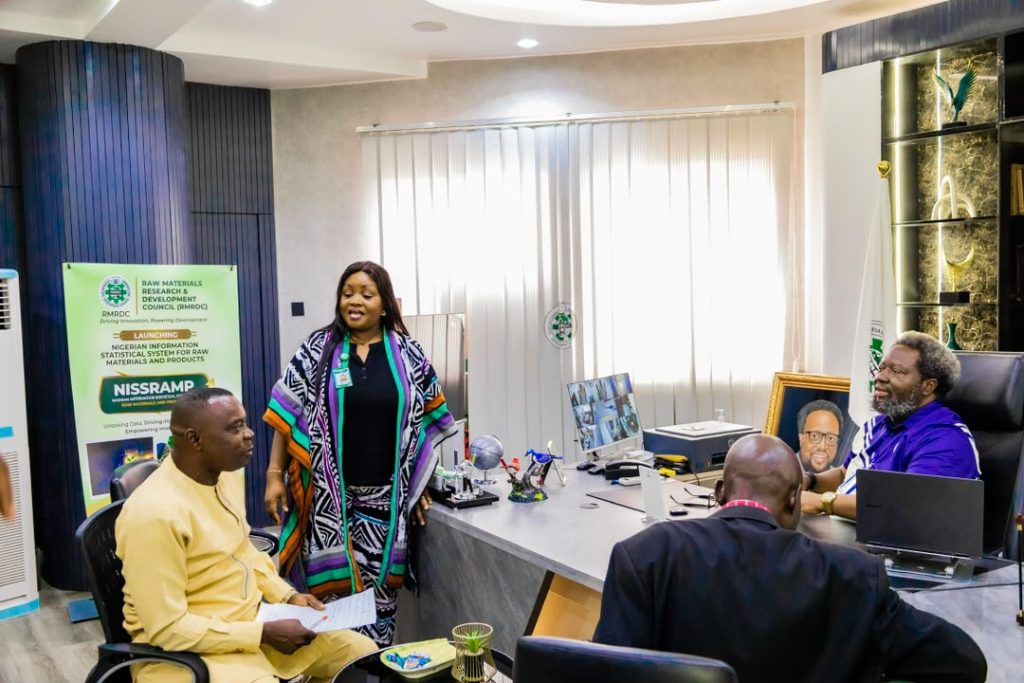
The DG further revealed that RMRDC recently launched the second generation of its Nigeria Integrated Information Statistical System for Raw Materials and Products (NISSRAMP), a digital platform designed to provide investors, manufacturers and researchers with reliable data for investment and industrial decision making. He described the platform as one of the country’s most comprehensive raw materials databases, currently linked to about 41 databases and accessible free of charge.
On the challenges facing the Council, Prof. Ike-Muonso identified funding as a major constraint, noting that while government support and funding for the Council have improved, they remain below the level required to fully deliver on its mandate. He, however, acknowledged the efforts of the government in providing increased support, adding that the additional resources have enabled the Council to advance some of its programmes and initiatives.
Despite the challenge, he expressed optimism that ongoing reforms, government support and the proposed value addition legislation would strengthen Nigeria’s industrial base and position the country as a processing hub for Africa’s abundant raw materials.
He reiterated that promoting local value addition remains one of the most effective pathways to creating jobs, attracting investment, conserving foreign exchange and achieving sustainable economic development.
Reflecting on the legacy he hopes to leave, the DG/CEO said he wants to be remembered for championing reforms that would free Nigeria and Africa from decades of exporting raw materials with little or no value addition.
According to him, the proposed 30 per cent value addition policy represents a major step towards ending the long-standing practice of exporting unprocessed raw materials while importing finished products at higher costs.
“I want to be remembered as the man who liberated Africa from the chains of raw material exploitation,” he said, expressing confidence that once the legislation becomes law, it could inspire similar reforms across the continent.