
By Chinyere Nnamdi-Anum, Adaora Adibe and Nafisat Abdulraham
A strategic partnership aimed at accelerating agro-industrialisation, strengthening food security, and driving local value addition is taking shape between the Presidential Food Security Coordinating Unit (PFSCU) and the Raw Materials Research and Development Council (RMRDC) as both institutions align efforts to deliver tangible outcomes under the Federal Government’s Renewed Hope Agenda.

The collaboration is focused on translating policy commitments into measurable results across key national priorities, including food stabilisation, increased agricultural productivity, investment mobilisation, job creation, and data-driven decision-making.

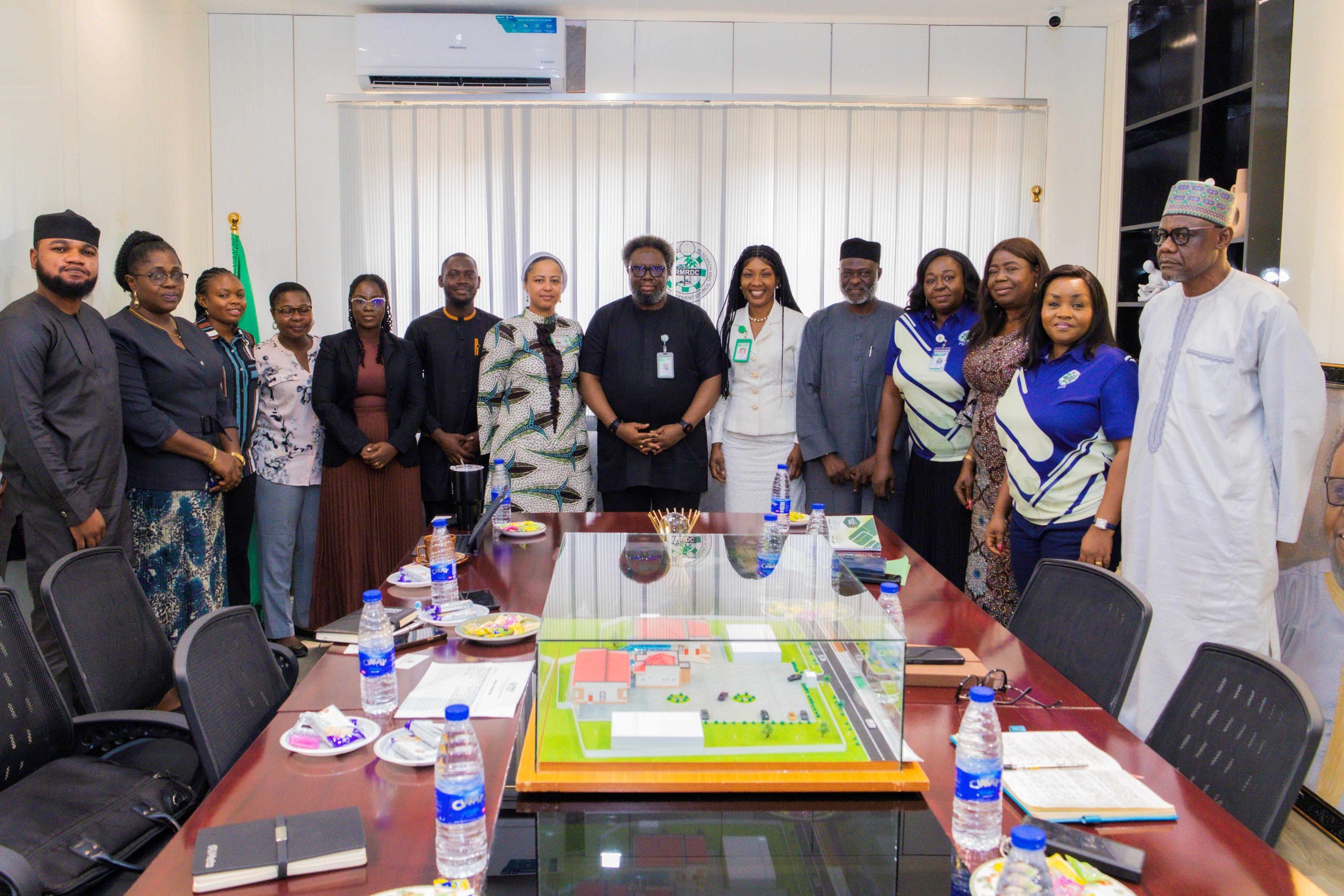
Speaking during the engagement at the RMRDC Headquarters Abuja, the Executive Secretary of the PFSCU Secretariat, Marion Moon, said the Unit operates across five key result areas: food stabilisation, food production, finance and investment, agro-industrialisation and job creation, as well as data, innovation, and institutional strengthening.
According to her, the food stabilisation pillar responds directly to the declared state of emergency on food security, while the other pillars are designed to boost productivity, unlock financing for the food system, promote value addition, and strengthen institutions through credible data.
You Might AlsoLike



“Our focus is to identify what is being done, who is doing it, and whether it delivers national impact in line with the Renewed Hope Agenda. Where it does, our responsibility is to elevate it as a priority so that policy commitments translate into real, measurable results for Nigerians,” Moon said.
She explained that PFSCU’s mandate involves identifying ongoing interventions, assessing their national impact, and ensuring alignment with federal priorities before elevating them for presidential consideration. She added that PFSCU is governed by a steering committee chaired by Vice President Kashim Shettima, with representation from the six geopolitical zones, key ministries, security agencies, local governments, the private sector, and development partners.

On agro-industrialisation, Moon said PFSCU is seeking closer collaboration with RMRDC, particularly in advancing the proposed 30% Value Addition Bill, noting that the Council’s mandate aligns directly with the administration’s industrial development agenda.

She also referenced recent policy interventions in the agricultural raw materials space, including the temporary six-month restriction on shea nut exports, introduced to protect local industries amid increased pressure on domestic supply. With the restriction nearing expiration, she said PFSCU plans to conduct a comprehensive assessment of its impact to guide future decisions.
The Director-General of RMRDC, Professor Nnanyelugo Ike-Muonso, reaffirmed the Council’s commitment to evidence-based policy support and disclosed plans to undertake a nationwide shea tree enumeration, including variety and age profiling, to enable medium-term supply forecasting. He identified funding as a major constraint but expressed optimism that collaboration with PFSCU would strengthen data collection, mapping, and deployment.
“Accurate data is critical to sustainability. With proper enumeration and analytics, we can make realistic projections on supply and guide investments that will strengthen the entire value chain,” Professor Ike-Muonso said.
He also highlighted RMRDC’s expanding data and product information systems, noting that such resources would be valuable to states, investors, and agro-industrial stakeholders, especially in driving informed investment decisions.
Also, the Director of Legal and Board Affairs, Barrister Ngozi Keshi, described PFSCU’s support for the Value Addition Bill as timely, noting that the legislation has the potential to significantly transform Nigeria’s agro-industrial sector.

As part of the engagement, PFSCU was officially invited to participate in the Africa Raw Materials Summit 2026, underscoring the growing collaboration between both institutions in advancing raw materials development, value addition, and industrial policy dialogue across the continent.
Members of the RMRDC management team present at the meeting included the Director, Legal and Board Affairs, Barrister Ngozi Keshi; Director, Planning, Statistics and Policy Department, Mrs. Tari Giwa Osagie; Director, Investment Promotion and Consultancy Services, Mr. Adamu Yaro; Director, Directorate of Corporate Affairs (DCA), Mrs. Chinyere Nnamdi-Anum, alongside other senior officials.
The engagement concluded with agreements to deepen collaboration through joint advocacy on the 30% Value Addition Bill as well as push for President Tinubu Assent on the bill, coordinated data initiatives by enumerating the shea trees algorithm, shea intervention and post-harvest assessments, and the signing of a Memorandum of Understanding (MoU) to formalise the partnership.
Both institutions expressed confidence that the collaboration would strengthen Nigeria’s food system, boost local processing, and support sustainable industrial growth.