By Otoikhila Emmanuel
The Raw Materials Research and Development Council (RMRDC) has joined key stakeholders at the Edo Leather Business-to-Business (B2B) Summit and Fair to advance efforts aimed at strengthening Nigeria’s leather industry value chain. The summit was organized in collaboration with the Edo State Government to promote sustainable growth, value addition, and competitiveness within the sector in Edo State and across the country.

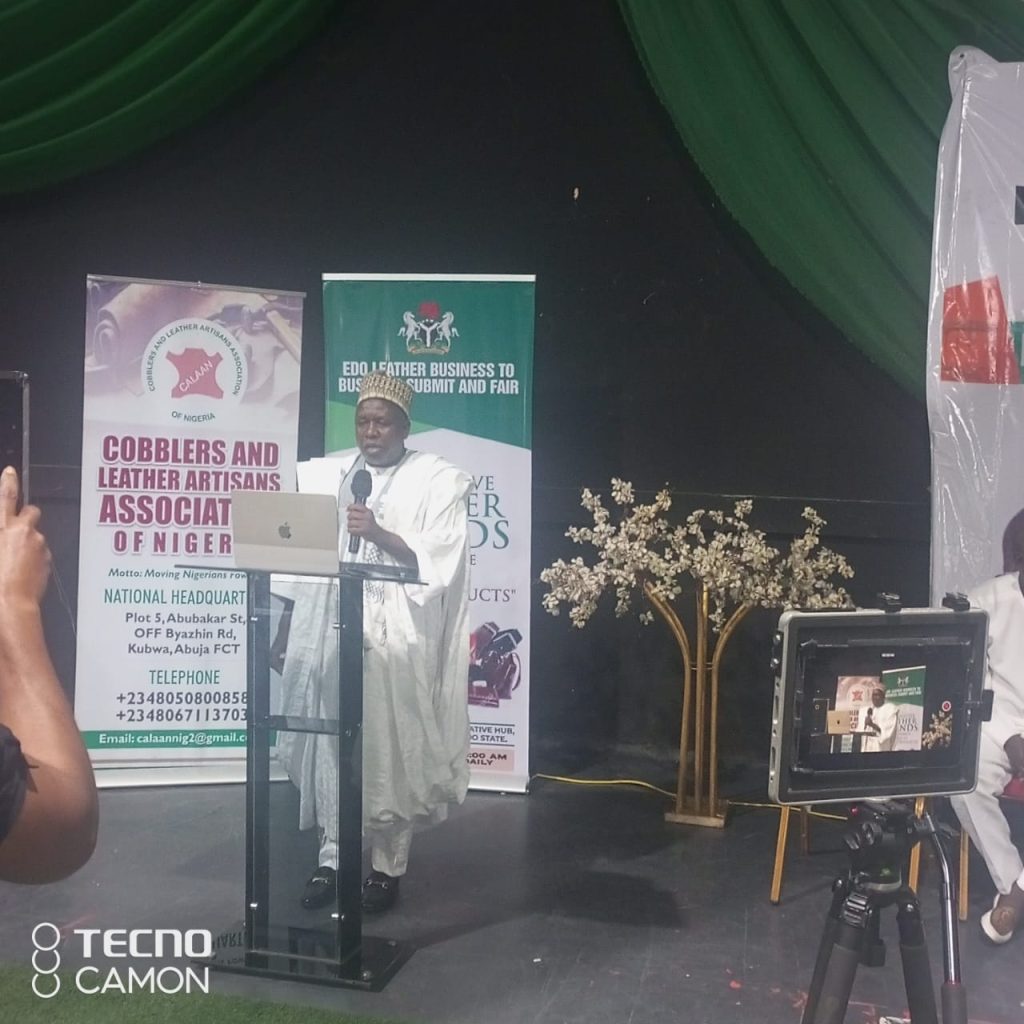
The summit, themed “Innovative Leather Brand,” was held on December 14, 2025, at the Victor Uwaifo Creative Hub, Airport Road, Benin City. It provided a platform for stakeholders across the leather value chain to deliberate on strategies for improving leather production, enhancing local value addition, attracting investment, and positioning Nigerian leather products for global markets.
A major focus of the summit was the creation of awareness on the economic importance of leather works, the promotion of the quality of Nigerian leather to investors and the international community, and the presentation of Edo State as a viable destination for leather industry investment. Participants also emphasized the need to discourage the consumption of hides and skins for food, popularly known as “kpomo,” in order to channel these raw materials into industrial processing and value-added production.
The event attracted several dignitaries, including representatives of the Edo State Government, industry leaders, and heads of professional and trade associations. Notable among them were the Executive Governor of Edo State, represented by Mr. Anator Omoh, General Manager of the Edo State Investment Promotion Office (ESIPO); Engr. Otoikhila O. Emmanuel, State Coordinator of RMRDC; Barr. Austin Atakpu, President of the Benin Chamber of Commerce, Industry, Mines and Agriculture (BENCCIMA); Engr. Godwin Eki Omoregie, Chairman of the Edo State Organized Private Sector (OPS); Mr. Osadolor Ehizogie, Chairman of the Manufacturers Association of Nigeria (MAN), Edo/Delta Branch; Pastor A.O. Balogun, President of the Edo State Shippers’ Council Association of Nigeria (SCAN); representatives of NASSI and NASME; and Alhaji Mustapha Nabegu, National President of the Leather Products Association of Nigeria (NALPAN), alongside representatives of financial institutions.
You Might AlsoLike



Participants included entrepreneurs, producers, manufacturers, and members of various associations within the leather and manufacturing ecosystem.
In his address, the National President of NALPAN, Alhaji Mustapha Nabegu, commended the organizing committee and acknowledged the support of the Edo State Government. He described the leather industry as a high-potential sector with abundant raw materials from hides and skins, skilled artisans, and established hubs in Kano and Aba. According to him, the sector is capable of generating over $1 billion annually but continues to face challenges such as infrastructure deficits, outdated technology, limited value addition, and environmental concerns, resulting in losses from the export of raw and semi-processed leather.
Speaking on behalf of the Edo State Government, Mr. Anator Omoh reaffirmed the state’s commitment to collaborating with the Leather Products Association and other stakeholders to develop the industry. He noted that the leather sector offers significant job creation opportunities, especially for youths, and disclosed plans by the state government to establish a dedicated leather industrial hub in Edo State, similar to those in Kano and Aba.

In his remarks, the RMRDC State Coordinator, Engr. Otoikhila Emmanuel highlighted the Council’s role in strengthening the leather value chain through policy support, research, and advocacy for local value addition. He noted that the leather industry contributes significantly to non-oil foreign exchange earnings, provides employment across the value chain, and has contributed an estimated 24 per cent to overall industrial growth.
Engr. Emmanuel also sensitized participants on RMRDC’s policy initiative advocating a minimum of 30 per cent local value addition before the export of raw materials. He explained that the initiative is designed to curb the export of unprocessed commodities, stimulate domestic industries, create jobs, promote economic diversification, and enhance Nigeria’s global competitiveness.
He reaffirmed RMRDC’s commitment to the optimal utilization of Nigeria’s natural raw materials as a foundation for sustainable industrial growth and economic development.
The summit concluded with a call for stronger collaboration among stakeholders to further strengthen the leather products value chain, with innovators providing technology and expertise, financial institutions offering funding solutions, government agencies creating enabling policies, and research institutions driving continuous improvement and sustainability.