By Stella Azi and Adaora Adibe
In a pursuit to improve corporate governance and revolutionise the Nigeria raw material sector, the Director General of the Raw Materials Research and Development Council (RMRDC), Prof. Nnanyelugo Ike-Muonso, led a team of senior management staff of the Council on a visit to the Nigeria Governors’ Forum (NGF) to deepen collaboration anchored on industrialization on data, innovation, and investment linkages while building state-level competitiveness and sustainability.

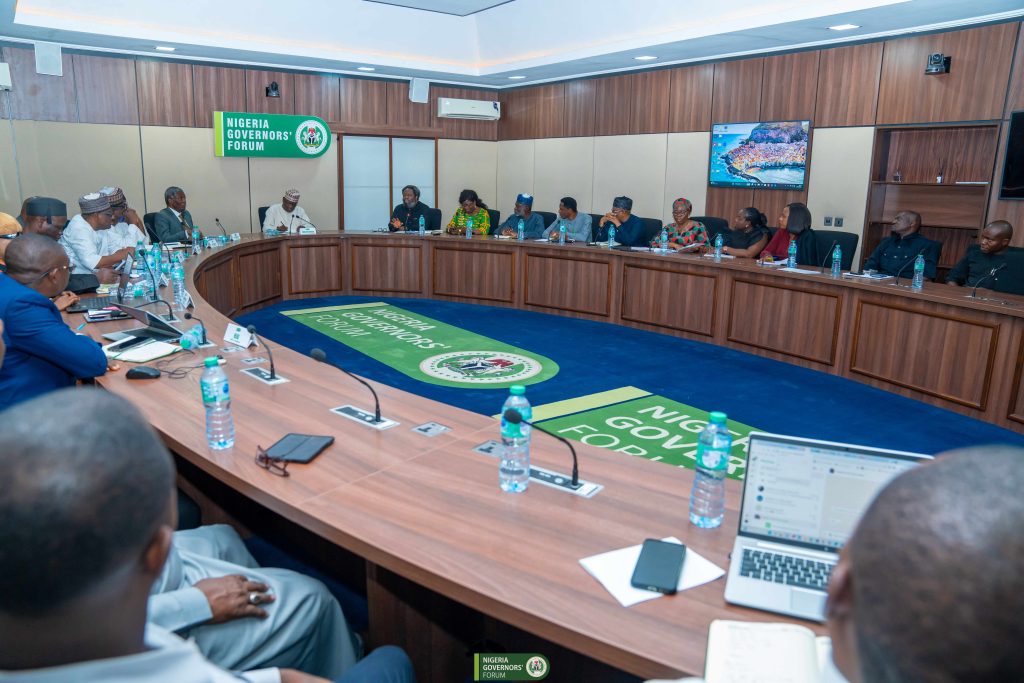
During the engagement, which took place at the boardroom of NGF in Abuja, on Monday, 11th October, 2025, Professor Nnanyelugo expressed delight to the Director-General, NGF, Dr Abdulateef Shittu, for the warm reception accorded him and his team. Presenting the RMRDC value proposition, the DG spoke on the Council’s eagerness to partner with the Forum in areas that could fundamentally reshape Nigeria’s raw materials landscape, from value addition legislation to geo-referenced resource mapping and smart storage technologies, etc.
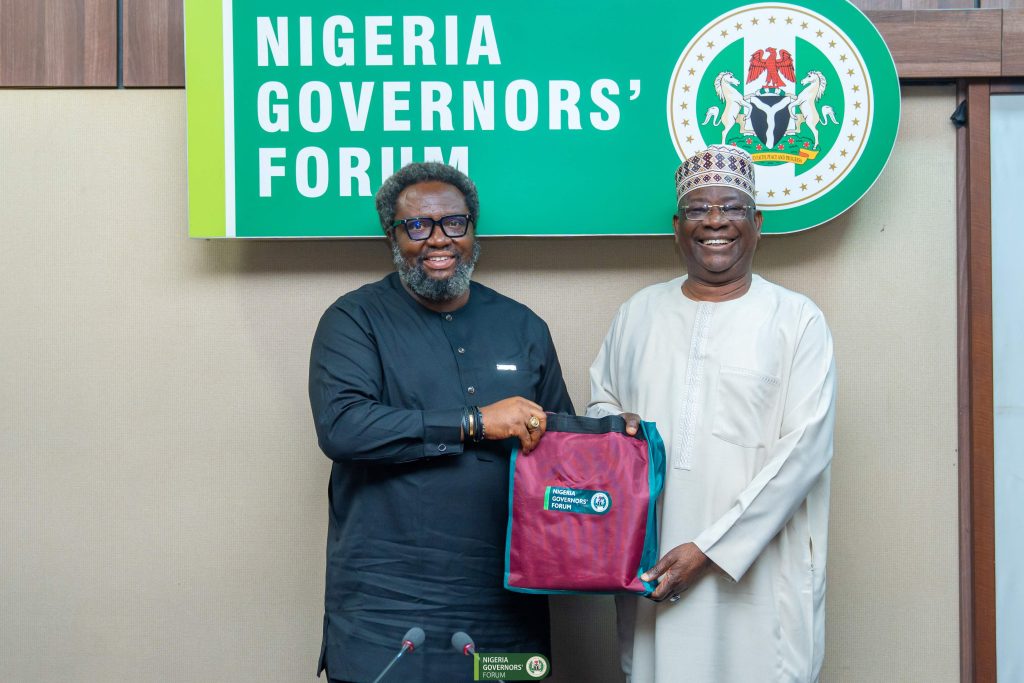
“We are excited to be here at the NGF; is a long-held wish being fulfilled,” Prof. Ike-Muonso said. “The economy of most sub-nationals is built around raw materials or their basic processing. “Our mission is to ensure that those resources are not only optimised for national development but protected from exploitation,” he said.
He revealed that one of the major initiatives the Council is currently pursuing is a legislative bill that will mandate at least 30% value addition to raw materials before they are exported. This, he said, would not only retain value within the country but also discourage illegal and exploitative extraction often facilitated by foreign agents. Over the years, he explained, the Council has tried policy persuasion, but believes legal backing will compel industries to adopt responsible practices.
You Might AlsoLike


Prof. Ike-Muonso further highlighted the Council’s ongoing work on the geo-mapping and digitalisation of raw materials across the country. This includes building a comprehensive digital dashboard that visually captures all raw materials, both solid, agricultural and waste in 3D format, along with their derivatives, economic potentials, extraction, processing costs and security conditions. “This data will help investors understand raw what exist in every state, what it can be used for and how to access it,” he added.
The DG also mentioned that the RMRDC recently commissioned a smart storage system facility developed by Professor Olubunmi Akinola of Progro Technologies limited.in Ogun State. According to him,this green technology innovation extends the shelf life of raw materials and significantly reduces post-harvest losses, a breakthrough which he believes should be adopted by state governments across the country.
Another core proposal presented was the creation of Model Raw Materials Resource Centres across Nigeria’s six geopolitical zones. These Centres would not only store physical samples but offer digital access and real-time data on the entire value chain. In addition, the Centre will act as investment intelligence platforms supporting MSMEs and industrial policy and empower states to showcase their raw materials potentials.

He also spoke about the Council’s National Programme on Backward Integration and Import Substitution, noting that consultants had already been invited to participate in the next phase of development. He emphasised the need for collaboration with states to deepen processing capabilities by establishing clusters and pilot processing facilities for region-specific raw materials.
Prof. Ike-Muonso stressed that beyond infrastructure and investment, education and awareness are key to empowering communities. “People have raw materials that can bring prosperity but don’t know the value. Often, it is foreigners who come in and exploit both mineral and agro-based resources. We need to provide the knowledge, the processing tools, and the incubation facilities that can turn these raw materials into prosperity, “ he added.
He also proposed a joint innovation and research fund between RMRDC and NGF, noting that a combined effort would have a greater impact on both policy and development. He pointed out that Nigeria’s economic strength at the subnational level is largely rooted in raw materials, and aligning NGF with RMRDC’s agenda could unlock immense value for the country.
In his response, the Director-General of the Nigeria Governors’ Forum, Dr Abdulateef Shittu, commended the RMRDC team and described the value proposition as timely and strategic. He said the forum is a non-partisan association founded in the year 1999 to promote good governance across the states. He said the forum has sector based on: Agriculture, Security, Energy, Climate, Investment, etc.
He noted that local content development is indeed synonymous with RMRDC’s mandate and expressed NGF’s willingness in this partnership to achieve shared goals. Dr Shittu stated that state governments, which have authority over land and subnational policy, are in a strong position to implement the kinds of reforms being proposed by the Council, describing the initiative as one that aligns closely with the NGF’s vision of building a strong, unified economy through collaborative governance.
Dr Shittu expressed interest in partnership for the proposed projects by the RMRDC, and announced that the NGF would quickly constitute a technical team comprising experts from both the Forum and RMRDC to develop a concept note and framework for the partnership. “We believe data is the oxygen for planning. Our analytics unit will work closely with yours to ensure we have the right information to drive this collaboration forward,” he said.
The DG concluded by reaffirming NGF’s commitment to working with RMRDC on digital resource mapping, data management, value addition, raw material characterisation, and local processing. “All your proposals align perfectly with our direction. We will work together and move fast,” he assured.
With both organisations aligned in vision and commitment, the partnership is expected to lay a strong foundation for a more sustainable, self-reliant, and industrialised Nigerian economy, powered by data, advanced local knowledge, and raw materials innovation.