By Musa Waziri
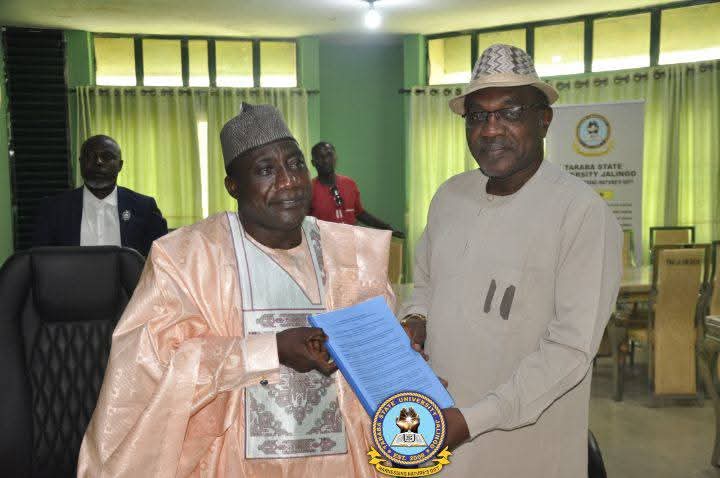
In a major push to transform Taraba State’s agricultural sector, Taraba State University (TSU) has signed a landmark Memorandum of Understanding (MoU) with the National Coffee and Tea Association of Nigeria (NACOFTAN), aimed at strengthening the production and value chain of five strategic cash crops. The agreement, facilitated through the CRIN-TSU Institute of Tree Crop Research, also includes the Raw Materials Research and Development Council (RMRDC) as a key technical partner.

The MoU was signed in the presence of the university’s Vice Chancellor, Professor Sunday Paul Bako, alongside members of the university’s management team, including Registrar Dr. Joseph U. Bibinu, University Librarian Dr. Israel Habibu, Director of Legal Services Barr. Joseph D. Bagudu, and Director of the Institute of Tree Crop Research Dr. Patrick K. Kefas.
A central feature of the agreement is the inauguration of an 11-member Technical Committee tasked with developing a strategic roadmap for sustainable tree crop development across Taraba State. The committee comprises five representatives from TSU, five from NACOFTAN, and one from RMRDC. Their mandate includes providing research-based, technical, and administrative guidance, and recommending implementation frameworks for the initiative.
The targeted crops: cocoa, coffee, tea, cashew, and kola were identified for their commercial potential and adaptability to Taraba’s diverse ecological zones. The initiative aims to bridge the gap between academic research and agricultural practice, creating a platform for innovation, commercialization, and value addition in the sector.
You Might AlsoLike


This development builds on an earlier agreement between TSU and RMRDC on strategic agricultural value chain development. With this new partnership, the university is further integrating into practical agriculture and industry-led research, positioning itself as a hub for sustainable crop production in Nigeria and the West African region.
Speaking at the ceremony, Professor Bako highlighted Taraba’s comparative advantage in tree crop cultivation. “Our highland-grown tea is among the best in Africa, yet it remains underutilized,” he said. “This partnership is about more than production, it’s about value creation, innovation, and inclusive growth.”
NACOFTAN President, Dr. Hassan Usman Kakara, described the collaboration as a turning point for Nigeria’s agricultural landscape. “The country currently produces only four million tonnes of tree crops against a demand exceeding 180 million tonnes,” he noted. “With Taraba’s rich ecological diversity across eight to nine local government areas, this partnership will significantly scale up production and market access.”

He also revealed that demonstration farms would be established in Donga, Ussa, Kurmi, and other fertile areas of the state, serving as training grounds for undergraduate and postgraduate students. These farms will focus on practical cultivation of coffee, tea, cashew, palm, cocoa, and shea butter.
Mr. Musa Waziri, RMRDC Taraba State Coordinator and the Council’s representative on the Technical Committee, lauded the initiative as both timely and transformative. “This project will expand crop production, create employment, and promote applied research,” he said. “Strategic partnerships like this are essential for long-term sustainability in agriculture.”
The Director of the CRIN-TSU Institute, Dr. Patrick Kefas, called the agreement historic and praised the Vice Chancellor’s leadership. He urged committee members to demonstrate commitment and professionalism in delivering on their mandates.
The collaboration is expected to catalyse a wave of agricultural development in Taraba State, with a joint postgraduate programme in agricultural value chain development, run in partnership with RMRDC, set to commence soon.